Sacred Ground: 7 Times Yoshiko Chuma Turned Ordinary Places Into Unforgettable Art
There's a certain kind of performance that lives inside you long after the last body has stilled and the crowd has scattered. It's not always the one that happened inside a velvet-seated theater with perfect lighting and a printed program. Sometimes — often, actually — it's the one that happened somewhere you never expected art to find you. A parking lot at dusk. A rooftop with the whole city humming below. A pier where the river smell mixed with the sweat of dancers moving like they owned the water.
Yoshiko Chuma has been engineering those moments for decades. Long before "immersive performance" became a buzzword plastered across arts festival brochures, she was out here quietly consecrating spaces that most people walked past without a second glance. Her instinct for location isn't just logistical — it's almost spiritual. She doesn't just use a space. She listens to it, argues with it, and ultimately transforms both the place and the people who show up to witness what she's made.
Let's walk through seven of the most legendary examples.
1. The Manhattan Rooftop Sessions
If you were plugged into downtown New York's experimental art scene in the 1980s, you probably heard about Chuma's rooftop performances before you actually saw one. Word traveled fast in those pre-internet days, passed mouth to ear at loft parties and gallery openings. When you finally climbed those stairs and emerged into open sky with the grid of the city stretching out in every direction, the effect was disorienting in the best possible way. Chuma used the verticality — the sense of elevation, of being above the ordinary — as a dramaturgical tool. Audiences didn't just watch the dancers. They watched them against the skyline, against clouds, against the slow crawl of traffic far below. The city became a co-performer.
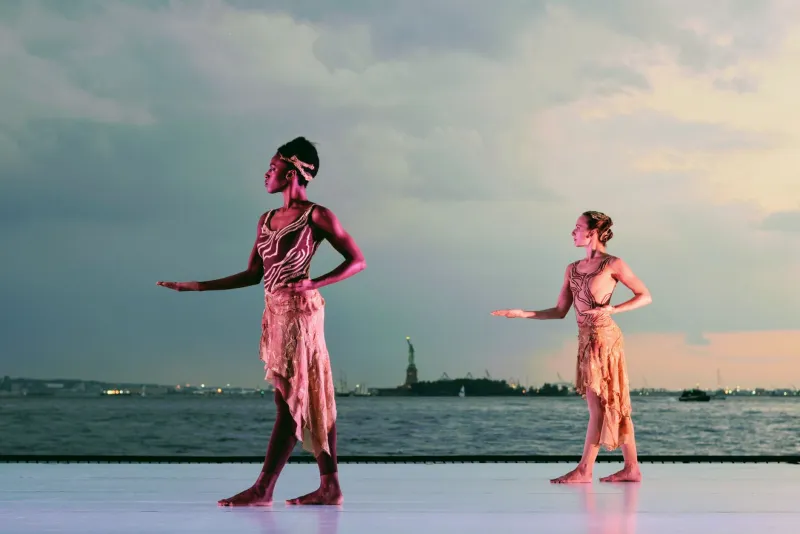
2. Hudson River Pier Performances
The West Side piers in the 1980s were contested, complicated territory — simultaneously beautiful and neglected, a gathering place for communities that mainstream New York preferred to ignore. Chuma chose them deliberately. Performing at the water's edge introduced an element of environmental unpredictability that no indoor venue could replicate: wind that changed the shapes bodies made in space, the sound of lapping water as ambient score, the industrial romance of rusting infrastructure framing movement that was anything but rusted. These pier performances anticipated by years the kind of waterfront arts programming that cities like New York, Chicago, and Baltimore now invest millions in cultivating.
3. The Parking Lot Piece
Asphalt is not a friendly surface. It's hard, unforgiving, and aggressively mundane. That's exactly why Chuma was drawn to it. One of her most talked-about site-specific works unfolded in a Lower Manhattan parking lot, where the geometry of painted lines and the residue of everyday commercial life became a kind of found choreography. Watching dancers navigate that grid — sometimes working with its rigid structure, sometimes deliberately violating it — made audiences suddenly see the parking lot as a designed space, a space full of implicit rules about how bodies should move and where they should go. Chuma broke every one of those rules, and in doing so, broke open the audience's assumptions too.
4. Public Plaza Interventions
New York's public plazas — those semi-private, semi-public spaces that proliferated as part of mid-century zoning deals — have always had an ambiguous relationship with actual public life. They're designed to look open while subtly discouraging the kind of lingering, gathering, and spontaneous activity that makes urban space feel alive. Chuma has staged performances in several of these plazas over the years, and the friction is always the point. Passersby who never intended to see a performance suddenly find themselves witnesses, then participants in their own attention. The plaza's corporate neutrality cracks open. For the duration of the piece, it belongs to everyone.
5. The Abandoned Warehouse Era
Before Williamsburg and Bushwick became synonymous with a certain kind of artisanal Brooklyn life, they were full of empty industrial buildings that artists used as raw material. Chuma was among those who understood what those spaces offered: volume, texture, history, and a kind of atmospheric weight that no purpose-built theater could manufacture. Her warehouse performances in the late 1980s and early 1990s played with scale in ways that were genuinely unprecedented — tiny human figures dwarfed by cavernous ceilings, the acoustics of concrete and steel reshaping sound into something almost architectural. Audiences moved through the space rather than sitting in fixed positions, which meant every person's experience of the work was subtly different.
6. Subway and Transit Space Performances
The New York City subway is already a theater — chaotic, democratic, occasionally transcendent, often deeply strange. Chuma recognized this and worked with it. Performances staged in and around transit spaces forced a confrontation with the idea of captive versus voluntary audiences. Commuters who had no intention of encountering art suddenly did. The question of who gets to decide when and where performance happens — and who gets to opt out — became part of the work itself. These pieces were among Chuma's most politically charged, using the infrastructure of public movement to ask questions about access, visibility, and whose bodies are considered worth watching.
7. International Site-Specific Work: Carrying the Practice Abroad
Chuma's site-specific practice was never confined to New York. As her reputation grew, she brought this approach to spaces across Europe, Asia, and beyond — adapting her curatorial instinct to radically different architectural and cultural contexts. What remained constant was the core methodology: arrive, listen, let the place speak, then create a conversation between bodies and environment that couldn't have happened anywhere else. This international dimension of her work is often underappreciated in American critical writing, but it's crucial. It demonstrates that her approach to space isn't rooted in any single city's geography or cultural moment — it's a genuinely portable philosophy of how performance and place can remake each other.
Why It Still Matters
We're living through a genuine boom in immersive and site-specific arts in American cities. Companies sell out shows in converted warehouses and abandoned hospitals. Festivals take over entire neighborhoods. Audiences line up to experience art in places that used to be purely functional. All of this feels very new to a lot of people — and in some ways it is. The production values are higher, the marketing is slicker, the Instagram opportunities are more carefully engineered.
But the roots of this moment go back further than most people realize, and Yoshiko Chuma's work is part of that root system. She was asking these questions — What makes a space? Who owns it? What happens when art enters it uninvited? What does a body do to a place, and what does a place do to a body? — before most of today's immersive theater companies existed.
The difference, maybe, is intention. Chuma wasn't choosing unusual locations for the novelty or the social media potential. She was choosing them because she genuinely believed that the right space could crack open something in both the art and the audience that a conventional theater never could. She believed — and demonstrated, again and again — that anywhere could be sacred if you brought enough attention and intention to it.
That's still a radical idea. And it's still hers.