Forget the Fourth Wall: 5 Ways Yoshiko Chuma's 'Infinite Stage' Will Rewire Your Brain About Live Art
Forget the Fourth Wall: 5 Ways Yoshiko Chuma's 'Infinite Stage' Will Rewire Your Brain About Live Art
Most of us grew up with a pretty fixed idea of what 'going to a show' means. You buy a ticket. You find your seat. The lights go down. You watch. You clap. You leave. It's comfortable, familiar, and honestly? Kind of limiting.
Yoshiko Chuma has spent her entire career poking holes in that model. Through decades of radical, boundary-smashing work with her company The School of Hard Knocks, she's developed what we at Yoshiko Chuma Universe like to call the 'Infinite Stage' philosophy — a way of thinking about performance that expands what a stage can be, who gets to perform, and what audiences are actually there to do.
Whether you've seen her work a dozen times or you're just discovering her now, these five principles can genuinely change how you engage with live performance. Not just her work — any work.
1. The Stage Is Wherever You're Standing
Let's start with the most fundamental shift: location. Traditional theater asks you to accept a very specific spatial arrangement — performers over there, audience over here, everyone in their designated zone. Chuma's work blows that arrangement up completely.
Her site-specific productions have unfolded in warehouses, public plazas, rooftops, and city streets. The 'stage' in her world isn't a platform with lights pointed at it. It's whatever space the work inhabits — and that space talks back. A performance in a Brooklyn park means something different than the same choreography in a Manhattan lobby, not because the movement changed, but because the environment is part of the meaning.
The takeaway for you as an audience member? Start paying attention to space. When you walk into any performance venue — conventional or otherwise — notice how the architecture shapes your expectations. Are you being funneled toward a fixed viewpoint, or are you free to move? That spatial logic is already telling you something about the art before a single performer steps onstage.
Next time you encounter site-specific work, resist the urge to find the 'right' spot and plant yourself there. Wander a little. Your changing position is part of the experience.
2. Collaboration Isn't a Buzzword — It's the Whole Point
Chuma has always worked with an extraordinarily wide range of collaborators — musicians, visual artists, filmmakers, dancers from completely different training backgrounds, and artists from cultures around the world. This isn't about checking boxes. It's a deep conviction that the most interesting art happens in the friction and flow between different perspectives.
Her cross-cultural collaborations, particularly between American and Japanese artistic traditions, have produced work that neither party could have made alone. The result isn't a compromise or a blended average — it's something genuinely new that emerges from genuine exchange.
For audiences, this means learning to read collaborative work differently. Instead of looking for a single unified vision with one clear author, let yourself notice the multiple voices present in the work. Where do they harmonize? Where do they pull against each other? That tension isn't a flaw — it's often where the most alive moments live.
When you're watching performance with a diverse creative team, ask yourself: whose movement vocabulary am I seeing right now? Whose aesthetic choices are shaping this moment? Getting curious about the collaboration behind the work deepens your experience enormously.
3. Big Casts, Organized Chaos, and the Beauty of Scale
Chuma's large-scale productions are legendary in the downtown New York performance community. We're talking dozens of performers moving through space simultaneously, creating something that feels simultaneously meticulously structured and genuinely unpredictable. It's controlled chaos, and it's intoxicating.
Most of us are trained to watch performance by following a single focal point — the lead dancer, the main character, whoever the lights are on. Large-scale work like Chuma's demands a different kind of attention. You literally cannot watch everything at once. You have to make choices about where to look, and different audience members will have genuinely different experiences of the same show.
This is actually a gift, once you let go of the anxiety that you might be 'missing something.' You're not missing something — you're having your specific experience. The person standing ten feet away from you is having theirs. The work is big enough to hold both.
Practice this: at your next performance with multiple things happening simultaneously, consciously shift your gaze every few minutes. Notice what you were ignoring. Notice what changes when you prioritize something different. You'll start to feel the architecture of the piece in a whole new way.
4. Your Body in the Room Is Part of the Equation
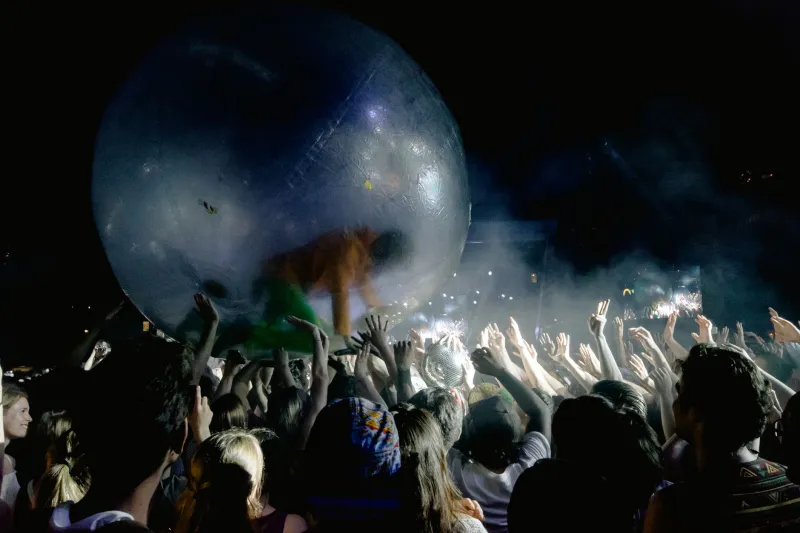
One of the most quietly radical things about Chuma's philosophy is the assumption that audiences aren't passive receivers. When you walk into one of her performances, your physical presence — where you stand, how you move, how your energy fills the room — is part of what makes the event what it is. A performance with a nervous, closed-off crowd feels different from the same performance with an open, curious one. The performers know it. The work responds to it.
This might sound a little woo-woo, but it's actually just honest about how live performance works. Theater and dance are not recordings. They're live events, and the aliveness comes partly from the human electricity in the room — all of it, including yours.
So show up awake. Put your phone away not just because it's polite but because your full attention is genuinely an offering to the performers and to the other audience members around you. Let yourself react — laugh if something's funny, hold your breath if something's tense. Your responsiveness isn't a distraction from the art. It's part of the art.
5. Not Knowing Is a Feature, Not a Bug
Here's the one that trips people up the most, especially if you're used to more conventional performance: Chuma's work doesn't always explain itself. It doesn't hand you a tidy narrative arc with a clear resolution. It asks you to sit with ambiguity, to let images and movements land without immediately demanding that they mean something specific.
For audiences raised on story-driven entertainment — which is most of us in the US — this can feel uncomfortable. The instinct is to ask 'but what does it mean?' almost defensively, as if not immediately understanding something is a failure.
Chuma's work invites you to flip that. Not knowing is the beginning of a conversation, not the end of one. When a sequence of movement leaves you uncertain, that uncertainty is information. What did it make you feel, even if you can't explain why? What images or memories did it call up? What questions is it leaving you with?
Experimental performance at its best doesn't give you answers — it gives you better questions. And Yoshiko Chuma, across decades of extraordinary work, has been generating better questions than almost anyone else in the game. The infinite stage isn't just a place. It's a state of mind. And once you step onto it, you'll never experience live performance quite the same way again.