Beautiful Wreckage: Inside Yoshiko Chuma's Philosophy of Falling Apart on Purpose
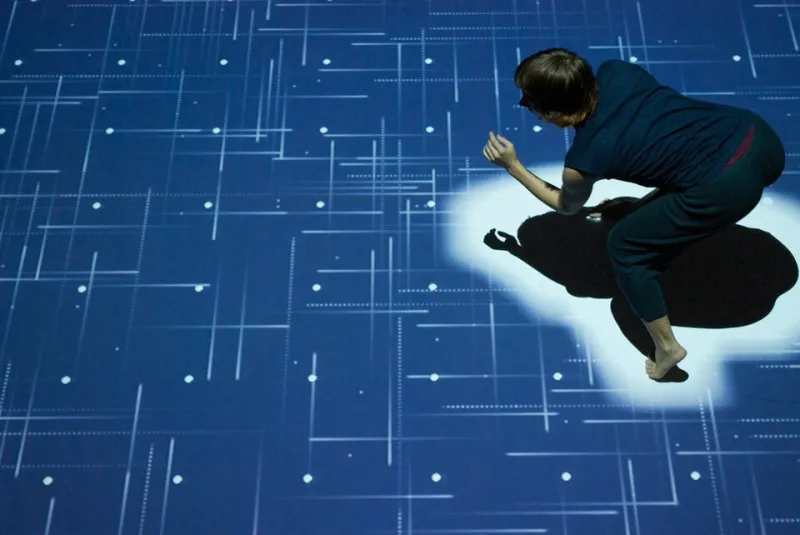
Photo: Trans-Media-Akademie Hellerau, CC BY-SA 2.0, via Wikimedia Commons
There's a moment in certain Yoshiko Chuma performances — and if you've been in the room for one, you know it — where something goes wrong. Or seems to go wrong. A movement doesn't land the way it looked like it was supposed to. A sequence breaks apart. A dancer stops and the silence stretches a beat too long.
And then you realize: you have absolutely no idea whether that was planned.
That uncertainty is the whole point.
The Perfectionism Trap
American dance culture has a complicated relationship with failure. On one hand, there's a well-worn mythology of the artist who learns from mistakes, who falls down and gets back up, who treats setbacks as fuel. We love that story. We put it on motivational posters.
On the other hand, the actual training infrastructure of professional dance is brutally perfectionist. You watch yourself in mirrors for hours every day. You drill sequences until they're automatic. You perform under conditions where a single stumble can feel catastrophic — to your body, your career, your sense of self. The message, delivered a thousand times in a thousand studios, is that excellence means the elimination of error.
Yoshiko Chuma looked at that system and built something almost entirely different.
Her practice doesn't treat failure as a thing to be overcome on the way to mastery. It treats failure — real, unscripted, uncontrolled failure — as a creative material. As something with its own texture and information and possibility. As something worth deliberately cultivating.
What "Permission to Fall Apart" Actually Looks Like
This isn't abstract philosophy. It shows up in concrete, sometimes disorienting ways in how Chuma works with her dancers.
People who've trained with her describe rehearsals where the goal isn't to get something right — it's to get to the edge of your competence and then keep going. To find out what happens in your body and your mind when the familiar scaffolding disappears. When you can't rely on muscle memory or technique or the safety of a well-rehearsed sequence.
One collaborator described it this way: "She'd give you a task that was technically impossible. Not metaphorically impossible — actually impossible, like asking you to be in two places at once, or to respond to something that hadn't happened yet. And the point wasn't to solve it. The point was to watch what you did when you couldn't solve it."
What you do when you can't solve it turns out to be extremely revealing. Some people freeze. Some people cheat — find a clever workaround that technically completes the task but avoids the real discomfort. Some people collapse into self-criticism. And some people, with enough practice and enough trust in the environment, find something unexpected. An instinct they didn't know they had. A quality of movement that only emerges under pressure. A moment of genuine presence that no amount of preparation could have manufactured.
Chuma is interested in that last thing. She builds conditions designed to produce it.
Why Imperfection Is Actually Honest
There's a deeper argument underneath all of this, and it's a philosophical one worth sitting with.
Perfectionism in performance is, at its core, a kind of lie. It presents the illusion of control — of a human body and a human mind operating with machine-like precision, unmarked by fatigue or doubt or the ordinary chaos of being alive. Audiences are trained to admire this. To see a flawlessly executed grand jeté and feel something like awe.
But what they're actually watching is an elaborate suppression. All the wobble and uncertainty and humanity that makes a body interesting has been systematically removed in the service of an ideal that was invented, not discovered.
Chuma's work refuses that suppression. When something falls apart in one of her pieces — when a dancer loses the thread, or a prop doesn't cooperate, or a sound cue arrives at the wrong moment — the response isn't to pretend it didn't happen. It's to absorb it. To let it become part of the work. To trust that the audience is intelligent enough to find something true and interesting in the mess.
This turns out to be enormously liberating for performers. And, perhaps surprisingly, it tends to produce work that audiences find more emotionally resonant, not less. Because they're watching something real — something that couldn't have been fully planned, something that's happening in front of them for the first time, shaped by actual conditions and actual human responses.
The Risk Economy
There's a timely conversation happening right now in creative industries about risk aversion — about how the economics of attention, the pressure of social media reception, and the general cultural anxiety of the moment are making artists more cautious, more conservative, more likely to self-censor or self-smooth before anyone else gets the chance to criticize.
It's a real problem. And Chuma's methodology is a pretty direct counter-argument to it.
Her approach asks: what if the riskiest thing you can do is also the most creatively productive thing? What if the work that might fall apart in front of an audience is more worth making than the work that's been polished into guaranteed safety?
Artists who've spent serious time in her orbit tend to answer yes to those questions. They describe a shift in their relationship to their own creative process — a willingness to start things without knowing where they're going, to show incomplete work, to treat a performance that doesn't quite cohere as more interesting than one that's airtight but lifeless.
This isn't recklessness. It's a carefully cultivated relationship with uncertainty. There's a difference, and Chuma's practice is very precise about that difference.
What Falls Apart, What Remains
Here's the thing about beautiful wreckage: it has a way of revealing structure. When you strip away the careful construction, when you let the seams show and the plan dissolve, what's left is whatever was genuinely there to begin with.
For a dancer, that might be a quality of physical intelligence that technique was actually hiding. For a performance, it might be an emotional truth that was getting smoothed over by production values. For an audience member, it might be an experience of genuine surprise and aliveness that the perfectly executed show never quite delivers.
Yoshiko Chuma has been excavating that territory for decades. And the artists she's shaped along the way carry that excavation into their own work — the understanding that falling apart, done with intention and awareness and trust, is not the enemy of great art.
It might be the whole point.