When the Plan Falls Apart: Yoshiko Chuma's Radical Embrace of the Unscripted Moment
When the Plan Falls Apart: Yoshiko Chuma's Radical Embrace of the Unscripted Moment
There's a particular kind of nerve required to stand in front of an audience and genuinely not know what's going to happen next. Most artists spend months — sometimes years — eliminating that feeling. Yoshiko Chuma has spent her entire career chasing it.
For anyone who's followed her work through the School of Hard Knocks, her long-running company, or tracked her wild, boundary-smashing performances across New York, Japan, and well beyond, this won't come as a shock. Chuma has always operated in a zone where structure and spontaneity aren't opposites — they're collaborators. But understanding how she actually pulls that off? That's where things get genuinely fascinating.
The Score Is Just the Beginning
Let's clear something up right away: Chuma does prepare. There are scores, there are frameworks, there are movement vocabularies established in rehearsal. She's not walking onstage and winging it in any shallow sense. But the difference between her approach and conventional choreography is that her structures are deliberately porous. They're designed with gaps — open seams where real-time decision-making can flood in.
This connects her directly to the legacy of John Cage, whose ideas about indeterminacy basically rewired what American experimental art thought was possible. Cage argued that a composer's job wasn't to control every sonic outcome but to set up conditions in which sound could happen. Chuma applies that logic to bodies in space. She sets up conditions. Then she lets the performance breathe — or gasp, or stumble — on its own terms.
The Fluxus movement, which exploded out of New York and Europe in the early 1960s, pushed this even further. Fluxus artists like George Maciunas and Yoko Ono treated scores more like recipes than blueprints — instructions that could yield wildly different results depending on who followed them, when, and in what mood. Chuma absorbed all of that. You can feel it in the texture of her work: the sense that you're watching something that is genuinely happening for the first and possibly only time.
Real Stakes, Real Time
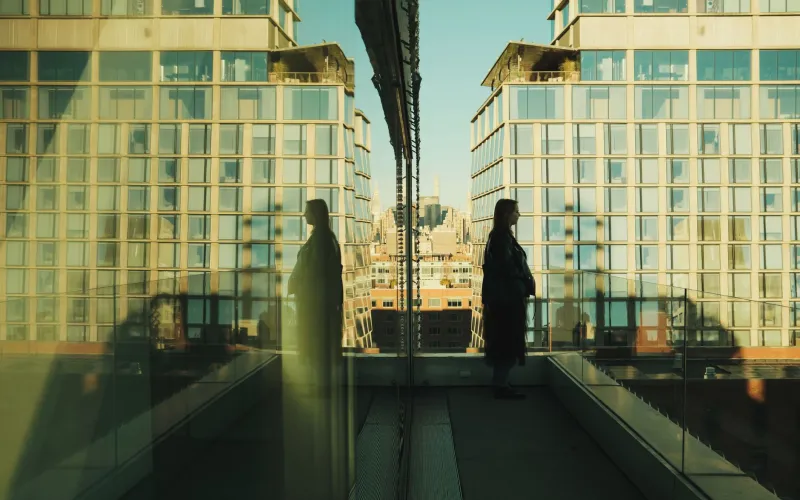
One of the most striking examples of this philosophy in action came during her sprawling multi-site performances, where she'd deploy performers across non-traditional spaces — rooftops, parking lots, public plazas — with only partial knowledge of what the others were doing. Coordination happened in real time. Performers had to read each other, read the environment, read the audience, and make choices on the fly. The choreography wasn't something fixed that they executed; it was something they discovered together, in front of everyone.
That's a completely different relationship to authorship. In a conventional production, the choreographer's vision is essentially locked in before opening night. Chuma's vision, by contrast, includes the possibility of failure, surprise, and genuine transformation. She's authored the possibility space, not the outcome.
And here's what makes that radical rather than just chaotic: there's still an aesthetic sensibility governing everything. Chuma's taste — her sense of timing, image, and physical intelligence — is present in every structural choice she makes. The unpredictability doesn't erase her voice. If anything, it amplifies it, because you can feel her trust in the moment as a creative force.
Why Surrendering Control Is Actually a Power Move
There's a counterintuitive thing that happens when you watch a Chuma piece that leans hard into chance: you become more alert. When audiences sense that the performers are genuinely navigating live decisions, the whole room wakes up. The usual passive spectatorship dissolves. You're not watching a recording of something that was figured out elsewhere — you're witnessing something that is being figured out right now, in your presence.
That aliveness is incredibly hard to manufacture. A lot of contemporary performance tries to simulate it with clever staging or immersive tech. Chuma achieves it by actually building genuine uncertainty into the work. It's almost a kind of honesty — a refusal to pretend that art is more controlled than life actually is.
She's talked in various contexts about her interest in the moment when a performer has to make a real choice, not a rehearsed one. That moment of authentic decision-making, she's suggested, is where something true enters the work. It's not mysticism — it's a very practical observation about attention and presence. When a dancer genuinely doesn't know what comes next, their body responds differently than when they're executing a memorized sequence. Audiences feel that difference, even if they can't name it.
The Influence She Doesn't Always Get Credit For
It's worth pausing to note that this approach — choreographing conditions rather than steps — has become increasingly mainstream in experimental dance and performance art over the past few decades. Scores, game structures, and improvisation frameworks are now standard tools in a lot of downtown New York work and beyond. Chuma was doing this before it had a trendy name.
Her influence on younger generations of performers and choreographers is real, even if it often travels through osmosis rather than direct attribution. The culture she helped build around the School of Hard Knocks — where risk-taking and structural openness were just the baseline expectation — shaped a lot of artists who went on to shape others.
Living Inside the Unknown
What ultimately distinguishes Chuma's relationship with chance from mere randomness is intentionality. She's not abdicating artistic responsibility — she's expanding its definition. Choosing to build uncertainty into a work is itself a deeply considered creative act. It requires enormous confidence in your collaborators, in the audience, and in the fundamental vitality of live performance as a form.
In a cultural moment when so much entertainment is optimized, pre-tested, and algorithmically smoothed, there's something almost defiantly human about an artist who says: I don't know exactly what's going to happen, and that's exactly the point. Yoshiko Chuma has been saying that for decades. The rest of us are still catching up.