One Suitcase, One City, One Revolution: The Raw, Restless Arrival That Made Yoshiko Chuma
There's a version of the Yoshiko Chuma story that starts with the accolades — the grants, the international tours, the collaborations that spanned continents and disciplines. But that version skips the good part. The real story starts with a suitcase.
Sometime in the late 1970s, Yoshiko Chuma left Osaka behind. She wasn't fleeing anything, exactly, but she was chasing something she couldn't quite name yet. Japan had given her a body trained in movement, a mind sharpened by discipline, and a restlessness that no single cultural container seemed big enough to hold. New York City, chaotic and half-broken and gloriously alive, was about to become her laboratory.
What She Packed (And What She Didn't)
When people talk about immigrant artists, there's a tendency to flatten the journey into a tidy before-and-after. But Chuma's migration was messier, richer, and more interesting than that narrative allows. She arrived carrying a specific physical vocabulary — one shaped by Japanese martial arts traditions, by the disciplined economy of movement that comes from years of training where every gesture carries weight. That wasn't something she left at customs. It came with her, quietly embedded in how she stood, how she entered a room, how she took up space.
What she didn't pack — couldn't pack — was the cultural scaffolding that made those movement instincts legible back home. In Osaka, her body spoke a language people recognized. In New York, she was suddenly untranslatable. And here's the thing about being untranslatable: it's terrifying, yes, but it's also weirdly liberating. When no one can place you, you get to decide what you mean.
Collaborators who knew Chuma in those earliest years in the city describe a performer who moved like she was simultaneously from everywhere and nowhere. There was precision, but it sat alongside a kind of wild openness — a willingness to let the work be incomplete, unresolved, still becoming. That quality wasn't an accident. It was the direct byproduct of living inside a question mark.
The City as Co-Choreographer
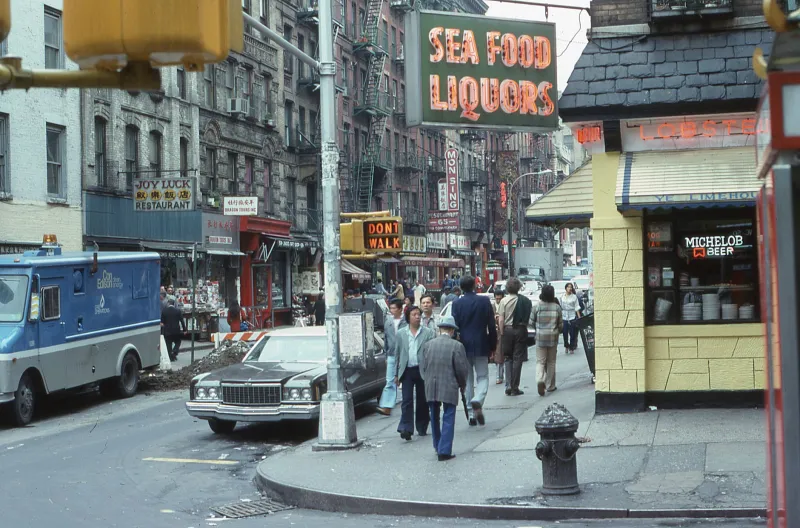
Late-'70s and early-'80s New York wasn't just a backdrop. It was an active collaborator. The city was broke, raw, and teeming with artists who had nothing to lose and everything to invent. SoHo lofts doubled as performance spaces. The line between rehearsal and performance, between art and life, was genuinely blurry in ways that aren't easy to recreate now that the neighborhood costs what it does.
For Chuma, landing in this environment was like arriving at the exact right moment for exactly the wrong reasons — which is to say, it was perfect. The downtown experimental scene of that era was allergic to polish. It was suspicious of mastery in the conventional sense. What it rewarded was risk, strangeness, and the courage to not-know in public. These happened to be exactly the conditions Chuma was already living in, not by artistic choice but by circumstance.
She found her way into the orbit of the School of Hard Knocks — the performing group she would eventually found — through connections made in that dense, overlapping social world where dancers, visual artists, musicians, and writers all seemed to be crammed into the same few square miles of lower Manhattan. The early performances she was part of were scrappy in the best sense: they had the urgency of people figuring something out in real time.
Accounts from those who saw her work in these formative years consistently mention a quality of presence that was hard to categorize. She wasn't doing postmodern dance the way other people were doing postmodern dance. She wasn't doing anything that mapped neatly onto what American audiences expected from a Japanese female performer, either. She occupied a space between those expectations and refused to resolve the tension.
Displacement as Choreographic Material
Here's what's easy to miss if you only look at Chuma's later, more celebrated work: the disorientation of her early years in America wasn't something she overcame. It was something she used.
The experience of being between cultures — not fully at home in either, constantly translating yourself for different audiences, never quite sure which version of yourself is the real one — that's not just an emotional state. For a choreographer, it's a physical one. It lives in the body. It shows up in how you move through space, how you relate to other bodies, how you handle uncertainty in real time.
Chuma's choreographic approach, which has always embraced the unfinished and the contingent, didn't emerge from an abstract aesthetic philosophy. It emerged from lived experience. When you've spent years navigating a world where the rules keep changing and the language keeps shifting, you develop a particular relationship to instability. You stop trying to eliminate it and start working with it. You build systems that can absorb surprise rather than systems that depend on control.
This is one of the things that made her work feel so electrically alive to audiences who encountered it in those early years. There was a genuine sense that anything could happen — because, for Chuma, anything genuinely could. She hadn't yet calcified into a style. She was still in the process of becoming, and the work reflected that.
The In-Between as a Place to Live
There's a concept in anthropology — liminality — that describes the threshold state between one condition and another. It's the space of transition, of not-yet and no-longer. Scholars use it to describe rituals, rites of passage, moments of cultural transformation. It also describes, pretty precisely, what Yoshiko Chuma was living through in those first years in New York.
The remarkable thing is that she didn't try to exit the liminal space as fast as possible. She took up residence there. She made it her aesthetic home. And in doing so, she created a body of work that speaks to anyone who has ever felt caught between worlds — which, in a country built on migration and reinvention, is a lot of people.
That's part of why her work still resonates so deeply with American audiences, even those who have no direct connection to her specific cultural background. The experience of being in-between, of carrying multiple identities that don't always sit comfortably together, of finding your footing in a place that wasn't built for you — that's not a niche experience. In this country, it's practically a founding condition.
What the Suitcase Left Behind
Decades on, Yoshiko Chuma is an institution — the kind of artist whose influence shows up in the work of performers who may not even know her name directly. But the origin story still matters. It matters because it reminds us that the thing that made her extraordinary wasn't a technique she learned or a style she adopted. It was a set of circumstances she refused to waste.
She packed a suitcase in Osaka with a body full of training and a head full of questions. She landed in a city that was in the middle of reinventing itself, surrounded by artists who were doing the same. And instead of trying to resolve the tension between where she came from and where she'd landed, she made that tension the work.
That's not just an interesting biographical footnote. It's a lesson in how displacement, handled with courage and curiosity, can become the most generative force in an artist's life. The suitcase was just the beginning.