The Family Tree Nobody Drew: How Yoshiko Chuma's Collaborators Are Building Their Own Worlds
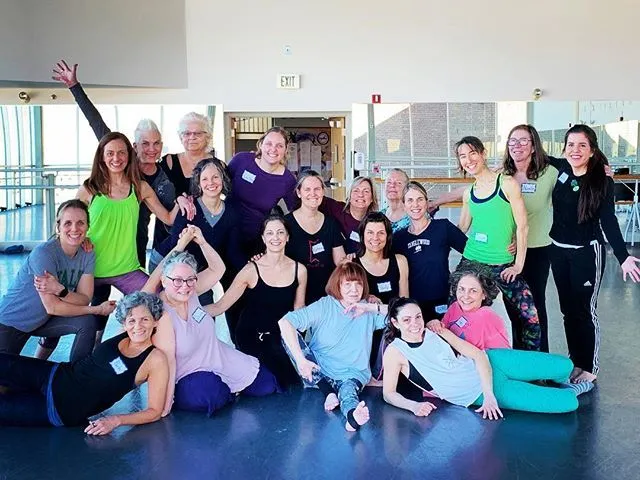
Photo: multigenerational dance workshop mentorship diverse artists collaborative studio, via i.pinimg.com
Artistic lineage is a funny thing to map. It doesn't move in straight lines. It branches, doubles back, skips generations, and occasionally produces something so far from the source that you'd never guess the connection without someone pointing it out. The creative family that grew up around Yoshiko Chuma's work is a perfect example of this — sprawling, varied, and in some cases actively in dialogue with the very ideas it inherited.
If you've been following experimental performance in the US over the past two decades, you've almost certainly encountered artists who passed through Chuma's world. Some of them are explicit about it. Others carry the influence more quietly. All of them are doing something interesting with what they absorbed, and taken together, they form a kind of distributed portrait of what Chuma's practice was always reaching toward.
What Gets Passed Down
Before we get into the individuals, it's worth asking what, exactly, gets transmitted in this kind of artistic inheritance. It's rarely technique in the narrow sense — a specific movement vocabulary or a set of formal rules. What tends to travel is something harder to name: a set of values, an orientation toward the work, a way of being in the room with other people.
From Chuma, what seems to have passed most durably is a particular relationship to uncertainty. Her collaborators describe learning, through working with her, to stay in the not-knowing longer than is comfortable — to resist the impulse to resolve a problem before it's fully revealed itself. That's not a lesson you pick up from a syllabus. It's something you absorb through repeated exposure to someone who actually lives it.
Also transmitted: a deep skepticism toward hierarchy in collaborative contexts. Chuma's process was famously non-pyramidal. The choreographer wasn't the only thinker in the room. Dancers, designers, musicians, and sometimes audience members were all understood as active contributors to what the work became. That's a structural commitment, not just a nice idea, and it shows up in how many of her former collaborators now run their own projects.
Profile: The Architect-Choreographers
Several artists who trained with or alongside Chuma have gone on to develop practices that blur the line between performance-making and community organizing. This isn't accidental. Chuma's work always had a social dimension — it was never just about what happened on stage, but about the relationships that made the stage possible.
One cluster of her former collaborators has built practices centered on site-specific work in underserved communities — bringing the same rigorous, open-ended process Chuma applied in downtown Manhattan lofts into community centers, schoolyards, and public parks in cities across the country. They've adapted the methods to contexts Chuma herself never worked in, and in doing so, they've expanded the argument for what experimental performance can be for.
What's notable about these practitioners is that they're not diluting the work to make it accessible. They're trusting that the core of the process — the genuine collaboration, the tolerance for mess, the insistence that participants are artists rather than audience members — works across contexts. And by most accounts, they're right.
Profile: The Second-Generation Teachers
Another branch of the family tree has moved into formal education, bringing Chuma-adjacent practices into university dance programs and conservatories. This is where the generational transmission gets particularly interesting, because these artists are now teaching students who have no direct memory of the downtown New York scene that formed Chuma — students for whom this approach to performance is simply how they learned to make work.
The question of what gets lost and what gets gained in that translation is genuinely open. Some things that felt radical in the context of the '80s and '90s avant-garde are now standard pedagogy in progressive MFA programs. That's partly a sign of success. But it also means that students may be learning the forms without fully grasping the stakes that originally animated them.
The most thoughtful second-generation teachers seem aware of this. They're deliberate about contextualizing the methods historically — about helping students understand not just how Chuma's approach works, but why it existed as a response to specific conditions, specific limitations, specific refusals. That historical grounding matters. Without it, you get technique without urgency.
Profile: The Challengers
Not everyone who came up in Chuma's orbit continued in a straight line from what they absorbed. Some of her most interesting artistic descendants are people who took what they learned and then deliberately pushed against it — who found the edges of her approach and decided to test them.
This is, arguably, exactly what Chuma would want. Her whole practice has been oriented toward questioning received wisdom, including her own. Artists who encountered her work and then spent years interrogating its assumptions are in some sense her most faithful inheritors — not because they agree with her, but because they're doing the same kind of rigorous questioning she modeled.
Some of these artists have developed practices that are more structured, more text-driven, or more explicitly political than Chuma's typically is. Others have moved toward forms — video art, installation, durational performance — that feel quite distant from her dance-centered roots. What they share is a quality of intellectual seriousness about the relationship between form and meaning, and a refusal to accept that relationship as settled.
What the Tree Tells Us
Looking at this whole extended community — the community organizers, the educators, the challengers, and the dozens of artists doing things that don't fit neatly into any of those categories — what you see is something that goes beyond individual influence. You see a set of values that have proven durable enough to survive translation across contexts, generations, and aesthetic commitments.
That's not nothing. In fact, it might be the best possible measure of an artist's impact: not whether their specific work gets replicated, but whether the questions they asked are still being asked, in new forms, by people who never even met them.
For Yoshiko Chuma, that legacy is very much alive. You can find it in rehearsal rooms and community centers and university studios all over the country. You just have to know what you're looking for — and maybe that's part of the point.

