Ripple Effect: The Next-Gen Choreographers Carrying Yoshiko Chuma's Fire Forward

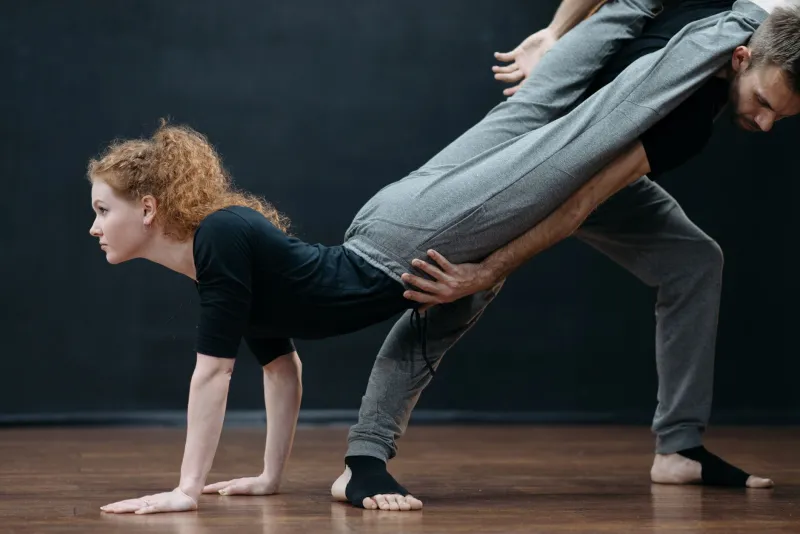
Photo: contemporary dance rehearsal studio diverse dancers collaborative movement, via i.pinimg.com
Yoshiko Chuma has never been the type to hand out diplomas. There's no certificate, no official curriculum, no branded method with a trademark symbol attached. And yet, if you spend enough time inside American contemporary dance — really inside it, past the polished concert stages and into the grimy rehearsal spaces and DIY festivals — you keep bumping into her fingerprints.
She's there in the way a choreographer in Chicago refuses to separate the performer's biography from the movement itself. She's there in a Brooklyn-based company that builds entire shows around found objects and half-improvised scores. She's in the bones of the work, invisible and everywhere at once.
That's the Chuma effect. And it's more alive right now than most people realize.
What She Actually Taught (It Wasn't Steps)
Let's be clear about something: Yoshiko Chuma's teaching legacy isn't about technique in the conventional sense. She didn't pass down a codified vocabulary the way a ballet master or a Graham-trained professor might. What she transmitted was something harder to name and, honestly, harder to unlearn once you've got it.
At the core of her philosophy is a radical insistence that the body already knows things the mind hasn't caught up to yet. You don't choreograph at the body — you listen to it, argue with it, follow it into uncomfortable territory. For dancers who came up inside rigid conservatory training, spending time in Chuma's orbit was often genuinely disorienting. In the best way.
She also pushed collaborators to dissolve the hierarchy between disciplines. Dancers in her orbit worked alongside visual artists, musicians, architects, and writers — not as supporting players but as co-creators with equal weight. That cross-disciplinary ethos has become almost standard in experimental performance today, but Chuma was modeling it decades before it became a grant-application buzzword.
The Mentees You Should Know
Spend any time talking to mid-career choreographers who came through New York's experimental scene in the late '80s through the 2000s, and Chuma's name surfaces again and again — sometimes as a direct mentor, sometimes as a gravitational force they orbited without ever formally studying with her.
Take the case of choreographers building work in the tradition of what's sometimes called "task-based" performance — where everyday gestures and actions carry the same weight as trained movement. That lineage runs directly through the kind of work Chuma was making with her company, School of Hard Knocks, at venues like P.S. 122 and La MaMa. The next generation absorbed that approach and carried it into university MFA programs, where it's now being passed to yet another cohort of young artists who may not even know where the idea originally came from.
That's how artistic DNA actually travels — not through textbooks but through osmosis, through watching someone work, through being in the room when a decision gets made that breaks every rule you thought was load-bearing.
In university settings specifically — think programs at places like NYU Tisch, CalArts, or the University of Illinois — you can trace the influence through faculty who trained in New York's downtown scene during Chuma's most prolific years. They brought her approach to risk, to community, and to the body-as-archive into classrooms across the country. Their students are now making work in cities that have nothing to do with Lower Manhattan, but the philosophical inheritance is unmistakable.
The Philosophy That Won't Sit Still
One of the most striking things about Chuma's influence is how adaptable it is. Her core ideas — that performance should disrupt rather than comfort, that the audience is never just a passive receiver, that the body carries knowledge that language can't fully capture — turn out to be remarkably portable.
A choreographer working with immigrant communities in Los Angeles can apply those principles to a completely different cultural context and produce something that feels both entirely their own and clearly downstream of Chuma's thinking. A performance artist in Atlanta building site-specific work in underutilized industrial spaces is operating in a tradition she helped establish, even if they've never seen a single one of her shows.
This is the real measure of a mentor's impact: not how many people can name-drop you, but how many people are unknowingly living out your ideas.
Why It Matters Right Now
Contemporary dance in America is at a weird, fascinating crossroads. Funding models are shifting. Audiences fragmented during the pandemic and haven't fully reconstituted. Institutions that once anchored experimental work are struggling or gone. In that environment, the kind of community-centered, low-hierarchy, high-risk approach that Chuma modeled for decades looks less like a quirky avant-garde experiment and more like a survival strategy.
The choreographers she influenced — directly and indirectly — are often the ones figuring out how to make work without institutional safety nets. They know how to build community because they learned from someone who treated community as the actual medium. They know how to work with non-dancers because they were taught that training isn't the only entry point to meaningful performance.
They know, in other words, how to be scrappy without being small.
The Invisible Lineage
Yoshiko Chuma doesn't always get the credit she deserves in mainstream dance history narratives. That's partly because her work resists easy documentation — it's live, it's participatory, it's often site-specific and therefore impossible to fully reproduce. It's partly because experimental performance, especially work made by immigrant artists of color, gets systematically undervalued in the canon.
But the lineage is real. It's in the work being made right now, in studios and warehouses and parking lots and community centers across America. The teachers teaching the teachers. The choreographers who swear their biggest influence was someone who was influenced by someone who spent three formative years watching Chuma break everything apart and put it back together differently.
That's not invisible, actually. Once you know what to look for, it's everywhere.