No Walls, No Boxes: How Yoshiko Chuma Blew Up the Idea of Performance Space
Let's start with a simple question: what is a stage?
For most of us, the answer is automatic. A raised platform. A proscenium arch. A black box with folding chairs. Maybe a thrust configuration if you're feeling adventurous. We've been trained — by school auditoriums, Broadway tickets, and high school talent shows — to understand performance as something that happens over there, while we sit over here.
Yoshiko Chuma never bought that arrangement. Not for a single second.
Since arriving in New York in the late 1970s and building her company, The School of Hard Knocks, into one of the most genuinely boundary-defying forces in American experimental performance, Chuma has operated from a fundamentally different premise: that the stage is everywhere, the audience is always already inside the work, and the environment — whatever it happens to be — is not a backdrop but a living participant in the art.
This isn't just a stylistic preference. It's a full philosophical framework. And it's reshaping how a new generation of artists thinks about performance space in the 21st century.
The 'Universe' Isn't a Metaphor — It's a Method
When Chuma talks about performance as a universe, she's not reaching for poetic language. She's describing a system — a web of relationships between bodies, objects, sounds, architecture, light, and the people watching (or wandering through, or accidentally stumbling in). In her framework, none of these elements are separate. They're nodes in an interconnected field, each one affecting and being affected by all the others.
Think about what that means practically. In a conventional theater, the set designer makes the space, the director tells the performers where to be, and the audience is a passive receiver at the end of the chain. The hierarchy is clear. The information flows in one direction.
Chuma collapses that hierarchy. In her productions, a shift in audience position can alter a performer's trajectory. The acoustics of a particular building might dictate the tempo of a sequence. A chance encounter between a cast member and an audience member in a hallway becomes part of the piece. Nothing is fixed. Everything is in conversation.
This is what she means by 'invisible architecture' — the structural logic of a performance that exists not in the set design or the script, but in the dynamic relationships between all the elements present in the room (or the street, or the parking lot, or the river).
Site-Specific Work as Radical Hospitality
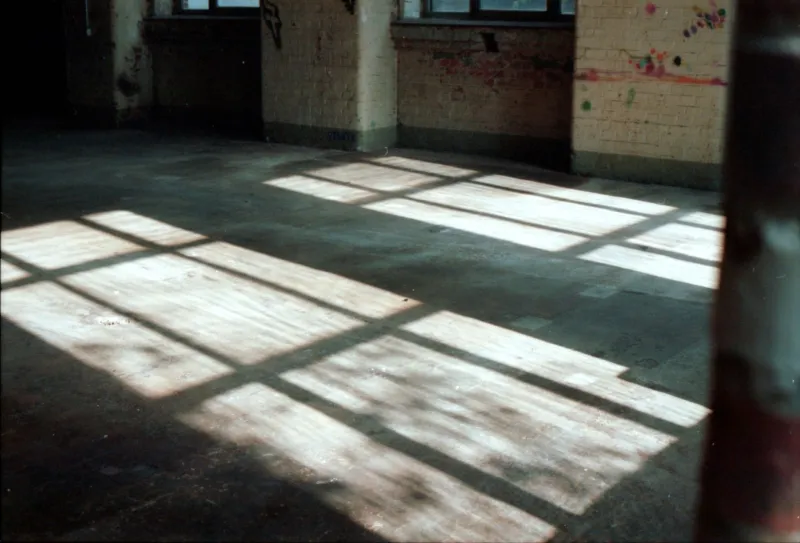
One of the most concrete expressions of this philosophy is Chuma's long commitment to site-specific performance. Over the decades, she has staged work in locations that would make a conventional producer's blood run cold — industrial warehouses, city parks, ferry terminals, public plazas, neighborhoods in the middle of active daily life.
But here's the thing: for Chuma, choosing an unconventional venue isn't a gimmick or a provocation for its own sake. It's an act of radical hospitality. By bringing performance into spaces that people already inhabit — spaces that belong to communities, not to arts institutions — she's making a statement about who performance is for.
When you stage a work in a Brooklyn warehouse or a Lower East Side street corner, you're not asking people to buy a ticket, dress up, and enter a specialized cultural space. You're meeting them where they are. You're saying: this art belongs to you too. Your presence, your neighborhood, your daily movement through this city — all of it is part of the work.
That's not a small gesture. In a country where access to high-art performance has historically been filtered through class, race, and geography, it's actually a pretty radical political act dressed up as an aesthetic choice.
What Contemporary Artists Are Taking From Her Playbook
The influence of Chuma's spatial philosophy is showing up everywhere in contemporary American performance — often in work made by artists who may not even know her name but are breathing the air she helped change.
You can see it in the explosion of immersive theater companies that have remade New York and other major US cities over the past fifteen years. The model of the audience moving through a multi-room environment, making individual choices about where to go and what to witness, owes a significant debt to the kind of spatial thinking Chuma was practicing decades before it became a trend.
You can see it in community performance projects that deliberately embed themselves in specific neighborhoods, treating local architecture and social geography as co-creators of the work. You can see it in installation-based performance, where the line between visual art and live art dissolves entirely.
And you can see it in a growing critical conversation about what performance venues should be — a conversation that's pushing back hard against the idea that arts infrastructure means expensive, purpose-built buildings in gentrified city centers. More and more artists and presenters are asking: what if the most powerful performance space is the one that's already embedded in a living community?
Chuma asked that question forty years ago. She's still asking it.
The Living Room as Laboratory
There's a quality to Chuma's spatial thinking that feels almost domestic — in the best possible sense. Her performances, even when they're large-scale and formally complex, tend to have a quality of intimacy, of being in a space together rather than attending an event. The distinction sounds subtle, but it's enormous.
When you're attending an event, you're a consumer. When you're in a space together, you're a participant. The power dynamic shifts. Your presence matters differently. You're not just receiving; you're part of the ecosystem.
This is the core of what Chuma's universe framework offers to contemporary performance-makers: a model for creating work where the audience's presence is genuinely constitutive of the piece. Not as an interactive gimmick, but as a structural reality. The work is literally different — literally a different universe — depending on who shows up and how they move through it.
In a moment when live performance is fighting to articulate its own irreplaceability in a world saturated with screens and streaming, that idea feels more urgent than ever. What does live performance offer that no screen can replicate? Exactly this: the irreducible fact of bodies in a shared space, making meaning together in real time.
Yoshiko Chuma has been building that argument — not in words but in practice, in piece after piece, space after space — for her entire career. The rest of the field is catching up.