Before the Lights Go Up: The Raw, Ritualistic World of Yoshiko Chuma's Rehearsal Process
Before the Lights Go Up: The Raw, Ritualistic World of Yoshiko Chuma's Rehearsal Process
Most people think of rehearsal as the unglamorous cousin of performance — the part where artists stumble through lines, bump into each other, and generally look nothing like the polished thing you'll eventually pay to see. Yoshiko Chuma would disagree with every cell in her body.
For Chuma, the weeks and months spent in a rehearsal room aren't a prelude to the art. They are the art. The stumbling, the arguing, the wild left turns that lead nowhere and then suddenly lead somewhere incredible — all of it is sacred. All of it counts. And if you've ever been lucky enough to witness one of her rehearsals, you already know this in your bones.
Starting From Nothing (On Purpose)
Here's something that might surprise you: Yoshiko Chuma rarely walks into a first rehearsal with a finished script, a locked-in concept, or even a clear sense of what the piece will ultimately become. That's not a bug in her process. It's the whole point.
She tends to begin with fragments — a visual image that won't leave her alone, a political question that's keeping her up at night, a piece of music that feels like it's asking something of her. From those fragments, she invites her collaborators into a conversation that is equal parts structured experiment and organized chaos. Tasks get assigned. Improvisations get thrown against the wall. Bodies move through space in ways that don't make immediate sense, and everyone in the room is encouraged to notice what happens when they do.
This approach demands a particular kind of bravery from everyone involved. You can't walk into a Chuma rehearsal expecting to be told exactly what to do and when to do it. You have to show up ready to not know things — and to find that genuinely exciting rather than terrifying.
The Room as a Living System
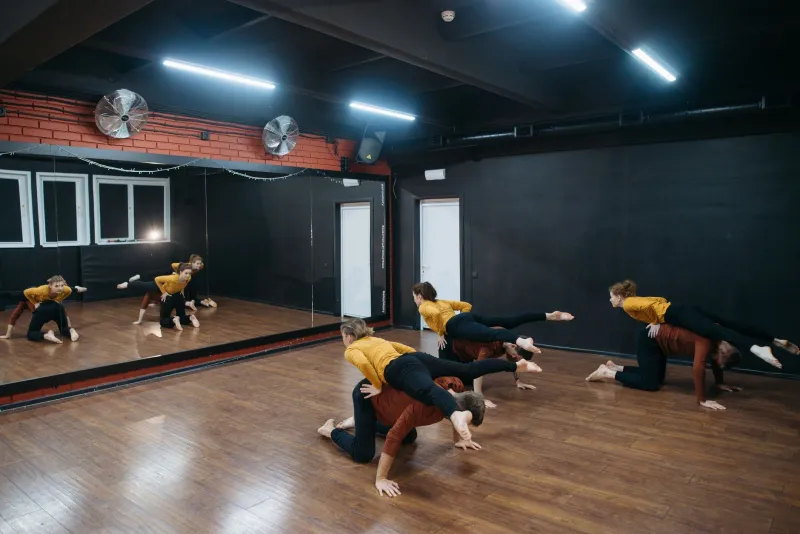
Longtime collaborators often describe Chuma's rehearsal space as something closer to an ecosystem than a workplace. Dancers, musicians, visual artists, and sometimes writers or filmmakers all occupy the same room, responding to each other in real time. Nobody is siloed into their discipline. The lighting designer might suggest a movement. A dancer might have opinions about the sound. Chuma herself moves fluidly between directing, observing, and participating — sometimes all three within the same ten minutes.
What this creates is a kind of collective intelligence that couldn't exist if everyone stayed in their lane. Ideas cross-pollinate in ways that are genuinely unpredictable. A gesture one performer makes in passing becomes the structural spine of an entire scene. A mistake — a missed cue, a body that falls when it wasn't supposed to — gets examined rather than corrected, because Chuma understands that accidents often know something the plan doesn't.
This is a philosophy that runs counter to a lot of how performance gets made in this country, where efficiency and clarity tend to be prized above all else. Chuma is more interested in depth than speed, and she's willing to spend weeks circling a problem before she's convinced she understands it well enough to move forward.
Risk as a Daily Practice
One of the things that distinguishes Chuma's rehearsal culture from more conventional approaches is her relationship to failure. In many professional dance and theater contexts, failure is something to be minimized — a source of embarrassment, a sign that you haven't prepared adequately. In Chuma's room, failure is practically a curriculum requirement.
She actively pushes her collaborators toward the edges of what they think they can do. Not in a punishing way, but in the spirit of genuine curiosity: What happens if you try that? What do you find out about yourself and about this piece when you attempt something that might not work? The answers, more often than not, are the most interesting things that happen all week.
This commitment to risk means that her rehearsals don't always feel comfortable. There are long silences. There are moments of real disagreement. There are afternoons where the work seems to be falling apart, where no one in the room can articulate what they're trying to make or why. Chuma doesn't rush past those moments. She sits in them. She asks questions. She trusts that the discomfort is pointing toward something worth finding.
Ritual, Repetition, and the Body's Memory
For all its openness to the unexpected, Chuma's rehearsal process also has its rituals. Certain warm-up practices recur across projects. There are ways of beginning a session and ways of ending one that create a container — a sense of shared intention that holds the work even when the work itself is uncertain.
Repetition plays a complicated role in her process. She'll return to the same sequence of movements again and again, not to drill it into mechanical precision, but to discover what changes each time. What does your body know about this phrase on the twentieth attempt that it didn't know on the fifth? How does meaning accumulate, shift, or dissolve with repetition? These are the kinds of questions her rehearsals are constantly asking.
There's something almost meditative about this approach — and intentionally so. Chuma has spoken openly about the influence of her Japanese background on how she thinks about time, patience, and the relationship between effort and emergence. In a culture that often prizes quick results and visible productivity, her willingness to let things develop slowly is itself a kind of quiet radicalism.
What the Audience Never Sees (But Always Feels)
Here's the paradox at the heart of Chuma's rehearsal philosophy: even though all of this extraordinary creative labor happens before anyone buys a ticket, audiences feel its presence profoundly. There's a quality to her finished performances — a sense of depth, of genuine discovery, of something at stake — that can only come from a process this rigorous and this alive.
When you watch a Yoshiko Chuma piece and feel like the performers are genuinely inhabiting something rather than executing it, that's not magic. That's the rehearsal room showing up in the work. All those weeks of risk and argument and accident and patience are somehow encoded in every gesture, every choice, every moment of unexpected stillness.
The rehearsal room, in other words, doesn't disappear when the curtain rises. It travels with the piece. It lives inside it.
And that might be the most radical thing about how Yoshiko Chuma makes art: she refuses to separate the making from the meaning. For her, they've always been the same thing.